
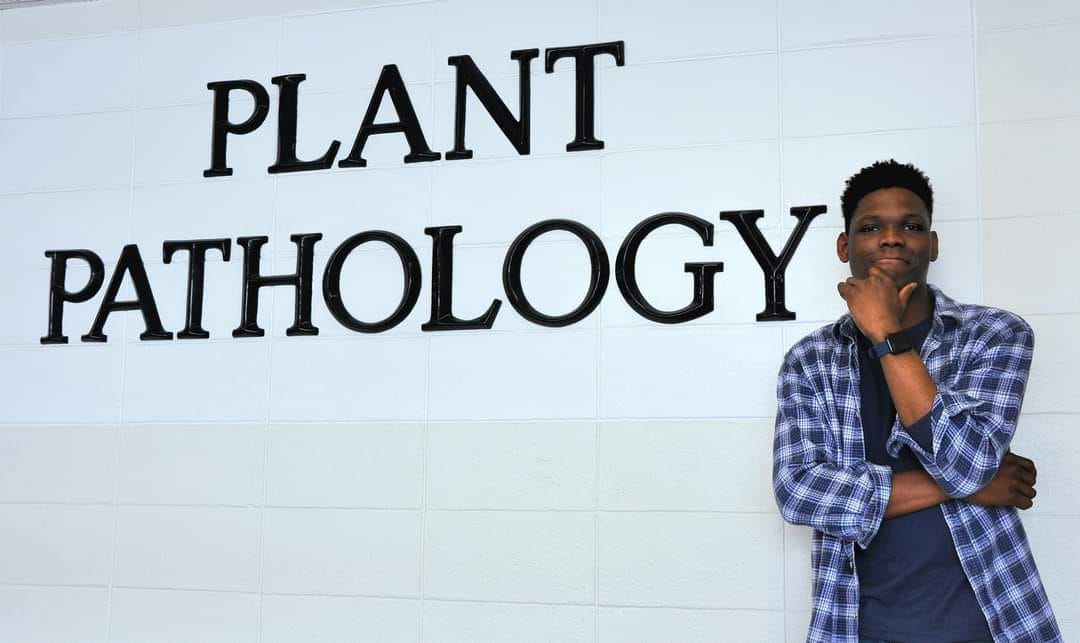
The extraordinary story of a FUTA graduate who turned rejection into resilience, a shoe-making side hustle into a scholarship mindset, and a spark from one classroom lecture into a Ph.D. at Iowa State University.
| 303+ Cold Emails Sent before first funded offer | $63,000+ Scholarships Won for MSc in the USA | 5+ Years of Leadership across 3 institutions |
The Making of a Plant Doctor: An Introduction
There is a particular kind of courage that does not announce itself loudly. It does not wait for perfect conditions, a first-class degree, or an encouraging response from the world. It simply keeps going — one email, one rejection, one lesson, one day at a time. That is the courage that defines the journey of Mayowa Samuel Aderoju, a plant pathologist, doctoral researcher, and emerging global leader in agricultural science.
Born in Oyo State, Nigeria, and forged in the classrooms and farmlands of the Federal University of Technology Akure (FUTA), Mayowa’s story is one of the most compelling examples of African academic excellence in recent memory. Today, he is a Ph.D. student at Iowa State University (ISU), a Committee Chair at the American Phytopathological Society (APS), a Corteva Agriscience DELTA alumnus, a Farm Bureau Fellow, a MANRRS Gold Scholar, and a globally published researcher. But none of it came easy — and that is precisely what makes his journey worth telling.
This is the full story of how a young man from Akure, Nigeria, with no first-class degree and no wealthy sponsor, sent over 303 cold emails into the silence of academia, endured rejection after rejection, and still emerged with over $63,000 USD in scholarships, a fully funded Master’s degree, and a Ph.D. that he is now using to protect the food supply of the world.
“I told my dad he would never pay my fees while I studied abroad — not because I had a sponsor, but because I believed it would happen.”
— Mayowa Aderoju
FUTA — Where Grit Is the Curriculum
The Federal University of Technology Akure is an institution with a reputation. Not just for its strong engineering and technology programmes, but for its rigorous, sometimes punishing, demands on its students. Mayowa arrived at FUTA in 2015, enrolling in the Department of Crop, Soil and Pest Management (CSP) — a department whose infamous farm work requirements deterred many. He was not one of those who turned away.
Embracing What Others Avoided
From his very first year, Mayowa made a decision that would quietly shape everything that followed: he would embrace his environment fully, regardless of how uncomfortable it was. The farm work was tedious. The academic demands were rigorous. But rather than resist, he leaned in, understanding early that resilience is built precisely in the spaces where comfort runs out.
The defining intellectual moment of his undergraduate years came in his third year, during a lecture by Dr. Ajayi. What began as another day in a CSP classroom turned into a revelation. Dr. Ajayi spoke about Plant Pathology not as an agricultural subject, but as the practice of being a plant doctor — diagnosing disease, saving crops, protecting food systems. For Mayowa, it was a calling, not just a course.
“When Dr. Ajayi entered our classroom, I immediately sensed his unique presence… His extensive and enlightening discourse made me forget that I was in a CSP class. From that moment on, I became deeply intrigued by what set Dr. Ajayi apart.” — Mayowa Aderoju
That single lecture sparked a career. Mayowa declared his focus on Plant Pathology and never looked back. He credits Dr. Ajayi not only with igniting his passion but with shaping his work ethic, mentoring him through his final year project, and ultimately helping to publish his undergraduate research — a rare and remarkable achievement for any Nigerian undergraduate student.
The Shoe-Making Entrepreneur
But Mayowa’s FUTA story is not just one of academic awakening. It is also one of extraordinary resourcefulness. When the university’s Entrepreneurship (ENT) course assigned him to learn shoe-making, most students treated it as a box to tick. Mayowa treated it as a business opportunity.
Within three days of his first lesson, he had produced his first pair of shoes. Within weeks, he was running a shoe-making operation across campus — from Abiola to Akindeko and back — generating enough revenue to pay his own rent and save money throughout his final year. He funded himself through the last stretch of his undergraduate degree not through family support, but through his own hands and ingenuity.
This entrepreneurial instinct — the ability to see opportunity in obligation — would prove to be a recurring theme in everything Mayowa pursued.
Building the Foundation: Certifications, Writing, and Leadership
Mayowa understood, even as an undergraduate, that a degree alone was insufficient. While classmates focused on passing exams, he was earning certifications in Nematology from the University of Arkansas, tutoring peers on writing IT reports, serving on the electoral board of his department, and playing in faculty football competitions.
He was a student who refused to be defined solely by his GPA. He left FUTA with a Second Class Upper Honours degree — not the first class that so many scholarship guides insist upon — but with a portfolio, a publication, an entrepreneurial track record, and a hunger that no grade could fully measure.
303 Emails — The Anatomy of Persistence
The path from FUTA to a fully funded Master’s degree in the United States is one that many Nigerian graduates dream about. For most, it remains a dream. For Mayowa, it became a lived reality — but only after one of the most grueling periods of professional rejection imaginable.
The Cold Email Campaign That Changed His Life
Mayowa’s approach to finding a graduate school opportunity was simple and brutal: reach out directly to professors whose research aligned with his interests, introduce himself, and ask if they were recruiting. It is a strategy recommended by graduate school advisors worldwide. It is also a strategy that produces mostly silence.
His first 100 emails generated zero responses. Not a single acknowledgement. He kept going. By email 200, still nothing. Most people would have stopped. Instead, he asked himself what he was doing wrong, reached out to his friend Emmanuel — already in graduate school — and was told flatly: “It’s a normal thing. Welcome to the club.”
That community of honesty kept him moving. He continued.
At email 210, he received his first reply — a professor who was not recruiting at the time, but who responded warmly and acknowledged his work. It was a small thing. It was everything. It told him that someone in academia, somewhere, found his profile worth responding to. He was on the right track.
“On the mark of 294th mail, I got another response: ‘I see you have a bright future ahead, but I am not recruiting at the moment.’ That gave me relief — I knew I was close to something great.” — Mayowa Aderoju
At email 303, it happened. A professor at North Dakota State University (NDSU) responded with genuine enthusiasm. He had read Mayowa’s undergraduate research on plant parasitic nematodes. He was interested. He was recruiting. He wanted Mayowa as his student.
After 303 emails, after months of silence, after the kind of sustained rejection that breaks most people — Mayowa had his offer. A fully funded Master’s degree. Over $63,000 USD in scholarships. A new life in America.
“I got my advisor who was so willing to fund my education and take me in as his student because he found my undergraduate work so interesting and wanted me to work directly under him. Yes! This was a dream come true for me.”
— Mayowa Aderoju
What makes this story even more remarkable is the timing. By the time he received that offer, NDSU’s admission deadline had already officially passed. Yet his scholarship came through anyway. In his own words: “I got in even when I never imagined.”
North Dakota State University — Excellence on a New Stage
Mayowa arrived at North Dakota State University in September 2022 to begin his Master’s degree in Plant Pathology. He arrived alone, in a new country, in a new academic system, with no family nearby — and he thrived.
Academic Achievement
His Master’s GPA at NDSU stands at 3.89 out of 4.0 — a performance that demonstrates not just intelligence, but the ability to maintain elite academic standards while simultaneously holding leadership positions, attending conferences, winning competitions, and building a professional network from scratch.
His research at NDSU focused on Sclerotinia sclerotiorum, a pathogen responsible for multiple devastating diseases in sugar beet — leaf blight, seedling damping-off, and root necrosis. He explored management strategies including varietal resistance, targeted fungicide applications, and cross-infectivity studies. In 2023, he presented this research at the PlantHealth25 Conference in Hawaii, representing the American Phytopathological Society’s African Division in a Special Session titled “Plant Pathologists of the Future.” Standing in Hawaii, on a global stage, presenting research he had conducted in North Dakota — it was a long way from Akure.
A Year of Milestones: 2023
Mayowa’s 2023 annual review reads less like a student’s year-end summary and more like a professional’s decade of achievement compressed into 12 months. Among his highlights:
- Presented at the 53rd Annual Sugar Beet Reporting Session
- Elected Vice-President of the NDSU Plant Pathology Organisation
- Attended the Corteva Agriscience DELTA’23 Symposium in Iowa
- Presented at the 75th North Central APS Conference at Purdue University
- Won the NC-APS Extension Flash-N-Dash Competition
- Earned his Federal Aviation Administration (FAA) UAS Remote Pilot License
- Featured in the Graduate Student Spotlight of the APS Newsletter
- Became Social Director of the Community of Nigerian Students at NDSU
- Received the Agricultural Microbiomes Thinkaton Travel Award
- Attended the APS Plant Health Conference in Denver
- Earned his Pesticide Applicator Certificate
- Became Co-Chair of Art-in-Phytopathology and Social Media Director for the APS Graduate Committee
- Completed all research objectives for his Master’s thesis
And as the year turned, he added one more milestone: becoming a recipient of the MANRRS 38th Gold Scholarship — one of the most prestigious awards available to minority students in agricultural sciences in the United States.
Community Builder and Leader
Beyond his academic and research achievements, Mayowa quietly built communities. As Social Director for the Community of Nigerian Students (CNS) at NDSU, he organised webinars and orientations for new students, collaborated with other schools and graduate organisations, and worked to foster belonging among international students navigating life far from home. He understood, from personal experience, how isolating that transition can be — and he committed himself to making it easier for those who came after him.
Corteva Agriscience — Bridging Research and Industry
In July 2024, Mayowa joined Corteva Agriscience — one of the world’s largest and most respected agricultural science companies — as a Biotechnology Intern in Johnston, Iowa. His focus: Trait Optimization for Plant Resistance to Diseases.
Corteva’s DELTA programme (which Mayowa participated in as a symposium attendee in 2023 before joining as a full intern) is designed to identify and cultivate the next generation of agricultural scientists. That Mayowa was selected speaks directly to the reputation he had built during his Master’s years — a reputation for rigorous research, strong communication skills, and genuine passion for the science of plant health.
The internship lasted a full year, from July 2024 to June 2025, and gave Mayowa direct industry exposure at the intersection of biotechnology and crop protection — exactly the kind of practical, industry-level experience that makes doctoral researchers not just scholars, but future leaders of the agricultural sector.
Iowa State University — The Ph.D. Chapter
In June 2025, Mayowa began his Ph.D. in Plant Pathology at Iowa State University, one of the premier land-grant universities in the United States and a global leader in agricultural research. He joined the ISU Seed Science Center under the mentorship of Professor Gary Munkvold — a world-renowned expert in seed health and disease management.
The Research: Protecting the World’s Food at the Source
Mayowa’s doctoral research focuses on seed-borne diseases — specifically, the diagnostic and management strategies for Bacterial Wilt of Dry Bean and Bacterial Tan Spot of Soybean, both caused by the pathogen Curtobacterium flaccumfaciens pv. flaccumfaciens. These are not obscure laboratory concerns. Dry beans and soybeans are among the most important protein crops in the world. Seed-borne bacterial diseases can devastate harvests, contaminate seed supplies, and threaten food security across multiple growing seasons.
His work at ISU involves developing seed health assays, evaluating varietal resistance across different cultivars, and designing integrated management strategies that can be adopted at scale by farmers and agricultural systems. This is research with real-world consequences — the kind that saves crops, secures livelihoods, and feeds communities.
A Bold and Faith-Driven Decision
What makes Mayowa’s Ph.D. journey particularly remarkable is how he chose his doctoral programme. Unlike most graduate students who apply to multiple schools simultaneously — creating an elaborate safety net of options — Mayowa applied to exactly one institution. Iowa State University. One application. One bet. One act of faith.
“I set aside my usual tendency to create endless backup options and surrendered this journey to God’s leading… I chose to hold on in faith, trusting completely that God is in control and always on time.” — Mayowa Aderoju, on beginning his Ph.D.
It paid off completely. And the message it sends — that sometimes focused faith outperforms scattered strategy — is one of the most powerful lessons in his entire story.
Leading the Next Generation of Plant Scientists
In August 2025, Mayowa was appointed Chair of the Graduate Student Committee of the American Phytopathological Society — the most prestigious organisation in the field of plant pathology globally. He had previously served as Vice Chair of the committee from July 2024, Chair of Social Media and Art-in-Phytopathology from 2023, and Board Member of the APS Office of Public Relations and Outreach from May 2023.
His appointment as Chair was spotlighted in Phytopathology News, Vol. 60, No. 03 — the society’s official publication — in a leadership feature that described his research, his advocacy for young plant scientists, and his commitment to the APS community.
In addition to chairing the graduate committee, Mayowa serves as Secretary of the APS African Division, contributing to the organisation’s efforts to build plant pathology capacity across the African continent. He also contributes to science communication through the APS Scientific Communication and Understanding Committee — reflecting his belief that great science must be communicated to be impactful.
“Leadership is about learning, impacting lives, and creating platforms where others can thrive.”
— Mayowa’s guiding philosophy, cited in APS Phytopathology News
Mayowa Aderoju: Full Career Timeline at a Glance
| Period | Role / Institution | Key Highlights |
| 2015–2021 | B.Agric.Tech, Federal University of Technology Akure (FUTA) | Second Class Upper Honours; funded himself through shoe-making business; published first research paper |
| Jun 2019–Feb 2021 | Agriculture Extension Officer, UTZ Certified (Rainforest Alliance) | Trained Nigerian cocoa farmers on export-quality agronomic practices |
| Nov 2021–Sep 2022 | Research Assistant Intern, University of Ibadan | Research on plant parasitic nematodes across Ondo State |
| Jun 2022 | Breakthrough Moment | Received first positive response after 303+ cold emails; secured fully funded MSc scholarship — $63,000+ USD |
| Jul 2022 | First Publication | First-authored research paper published — a landmark achievement as an undergraduate |
| Aug 2022–May 2024 | MSc Plant Pathology, North Dakota State University | GPA 3.89/4.0; VP of NDSU Plant Pathology Organisation; APS Graduate Committee Co-Chair; NC-APS Flash-N-Dash Competition Winner |
| Jul 2024–Jun 2025 | Biotechnology Intern, Corteva Agriscience | Trait optimization for plant resistance to diseases at one of the world’s leading agri-science companies |
| Jun 2025–Present | Ph.D. Researcher, Iowa State University | Seed-borne disease diagnostics and management under Prof. Gary Munkvold at the ISU Seed Science Center |
| Aug 2025–Present | Chair, APS Graduate Student Committee | Leading the graduate student body of the American Phytopathological Society — spotlighted in Phytopathology News Vol. 60, No. 03 |
Seven Lessons from Mayowa’s Journey for African Students and Professionals
Mayowa’s path from FUTA to Iowa State is more than an inspiring biography. It is a masterclass in the strategies, mindsets, and habits that determine whether ambition translates into achievement. Here are seven lessons drawn directly from his experience:
1. A First-Class Degree Is Not the Only Door
Mayowa graduated with a Second Class Upper from FUTA — a very strong result, but not the mythologised first class that many students believe is required for international scholarships and graduate school. His story dismantles that myth completely. What distinguished him was not a perfect CGPA, but a combination of research experience, publications, certifications, leadership roles, and a compelling personal narrative. Grades matter; they are not everything.
2. Persistence Is a Number — Keep Counting
303 emails. That is the number it took. Not 10. Not 50. Not 100. Three hundred and three. The willingness to send one more email after each rejection, to refine the approach, to stay in the game, is what separated Mayowa from thousands of equally qualified Nigerian graduates who gave up earlier. Persistence, in his case, is not a vague virtue — it is a documented, quantifiable commitment.
3. Start Building Before You Need It
By the time Mayowa sent his 303rd email, he had already built a portfolio: a published paper, certifications from three US universities, internship experience, and a track record of leadership. He did not build this portfolio after receiving an offer. He built it before, in anticipation of an opportunity he could not yet see. That advance preparation is what made him attractive to a professor who had never met him.
4. Find Your Spark — Then Chase It Relentlessly
One lecture by Dr. Ajayi changed everything. Mayowa did not know he would become a plant pathologist until that classroom moment. But once he knew, he committed fully — choosing plant pathology as his research focus, volunteering at IITA, interning at the University of Ibadan, and ultimately building an entire career around that original spark. Know what moves you, then move toward it without hesitation.
5. Community Is Not Optional — It Is Infrastructure
Emmanuel, his classmate who first introduced him to graduate school. Dr. Ajayi, who supervised and published his undergraduate work. Dr. Milton Babajide Macaulay, who ran the Illumania Scholarship Edition that opened his eyes to what was possible. His NDSU supervisor, Dr. Mohamed Khan. Each of these people were not accidental encounters — they were the product of Mayowa putting himself in rooms, asking questions, and showing up consistently. Community is not a nice-to-have; it is the infrastructure on which individual achievement is built.
6. Use Every Tool Available — Including LinkedIn
Mayowa is explicit about the role LinkedIn played in his career. It connected him with information, opportunities, and people who proved instrumental to his achievements. For African professionals navigating international career paths, LinkedIn is not a vanity platform — it is a genuine career accelerator. Use it with intention.
7. Bet on Yourself — Even When the Odds Seem Unclear
He told his father he would never pay for his postgraduate education, without a sponsor in sight. He applied to one Ph.D. programme when convention said to apply to many. He sent email number 303 when the rational response would have been to stop at 100. At every juncture where the safe choice was available, Mayowa chose the bold one — and it kept paying off. The ability to bet on yourself, sustained over years and across hundreds of small decisions, is the compound interest of ambition.
What Mayowa Is Working On Right Now
As of 2026, Mayowa Aderoju is fully immersed in doctoral research at the ISU Seed Science Center. His day-to-day work involves designing and running seed health assays to detect and quantify Curtobacterium flaccumfaciens pv. flaccumfaciens in commercial and experimental seed lots, evaluating the resistance of different dry bean and soybean varieties to bacterial infection, developing and testing integrated management protocols that can reduce seed-borne disease incidence and severity, and contributing to the scientific literature on bacterial disease management in legume crops.
He continues to lead the APS Graduate Student Committee, mentoring emerging plant scientists, organising networking events, and representing the next generation of the discipline on the international stage. He also continues his work as an Ambassador for Paragon One and as a freelance content writer for Wikifarmer, contributing educational agriculture content to farming communities across the globe.
Why Mayowa’s Story Matters for Africa
Plant diseases destroy an estimated 20–30% of global crop yields every year. In sub-Saharan Africa, where agriculture employs over 60% of the workforce and underpins national food security, the consequences of unmanaged crop disease are not abstract — they are hunger, poverty, and lost livelihoods.
Africa needs more plant pathologists. It needs researchers who understand the continent’s specific crop systems, its pathogens, its soil conditions, and its smallholder farmer realities. It needs scientists who can bridge the gap between laboratory discovery and farm-level implementation. Mayowa Aderoju is being trained — at the highest levels of global science — to be exactly that kind of scientist.
His research on seed-borne diseases is globally significant, but its implications for African agriculture — where seed systems are often informal, disease surveillance is limited, and management resources are scarce — are profound. When he returns, or when he contributes to African agricultural research networks from wherever he is in the world, the knowledge he is building now will matter immensely.
And beyond the science, his story matters for the tens of thousands of African students who look at the gap between where they are and where they want to be, and wonder whether it is crossable. Mayowa’s answer, written in 303 emails and $63,000 in scholarships and a Ph.D. in Iowa, is unambiguous: it is crossable. It always was.
“If you can survive FUTA, you can survive anywhere in the world. Quote me anywhere.”
— Mayowa Aderoju
Mayowa’s Advice to Young African Scholars
When asked what he would tell young scholars still navigating their undergraduate years or early career paths, Mayowa offered four pieces of direct, unvarnished advice:
- Erase the notion that without a first class, you cannot do great things. A first class is excellent — but first class alone is never enough. Build your portfolio beyond your grades.
- Find your passion and start working towards it now. You are never too late, but the best time to start is always the present moment.
- The journey requires resilience, courage, and unwavering focus. Distractions are expensive — they cost you the things you really want. Stay the course, and you will be rewarded.
- Do not give up. Whatever you do, in all circumstances and through all discouragements — do not give up.
Mayowa Samuel Aderoju did not become a global plant pathology leader because the world made it easy for him. He became one because he refused to accept the version of his future that circumstances initially offered. He took a CSP course that most people avoided, and made it his identity. He sent 303 emails and received 302 non-responses, and kept going. He told his father a promise he had no guarantee of keeping, and then kept it.
Today, in a laboratory at Iowa State University, he is working to protect the seeds from which tomorrow’s food will grow. The young man who once made shoes in Akure to pay his rent is now building the scientific foundations for food security on a global scale.
That is not just a success story. That is a testament to what African excellence, properly nurtured and relentlessly pursued, looks like in practice.
Watch this space. Mayowa Aderoju is just getting started.